Narayan Ravi - Mumbai
Pavanapuresha-Series
Part-4
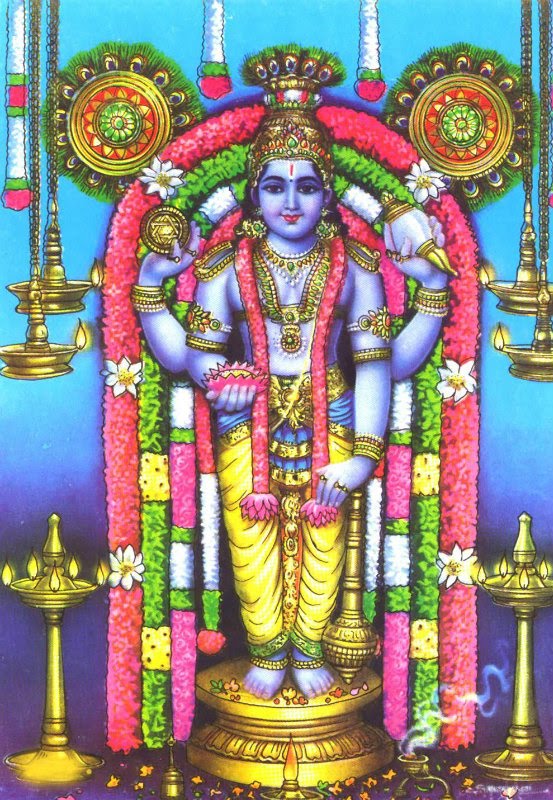
Pavanapuresha series part 4: Significant features of temple architecture - featuring the story of the temple fire of 1970.
The Guruvayur temple was first constructed by Vishwakarma, the architect of the Gods. Over the centuries it has been rebuilt many times. One striking feature of Vishwakarma's construction is that on the day of Vishu, the first rays of the rising sun fall on the lotus feet of the Lord, as if the Sun Himself were prostrating before the Lord. When one speaks of the architecture of Guruvayur, the 110 ft
Dhwajastambha(flag staff), commonly called 'Kodimaram' is what comes to mind. Passing by this, once inside the 'Nalambalam', the inner shrine, one sees 5 pillars on each side. The pillar immediately to one's left as one enters inside is considered particularly sacred since it is believed that Narayana Bhattathiri used to often sit here leaning against this pillar while writing the Narayaneeyam. This and the one opposite to it on the other side were not replaced while the other 8 pillars were replaced after the temple fire of 1970. The temple well to one's right as one approaches the Srikovil is believed to be blessed with the presence of Varuna - the god of the seas & oceans. Right below the Sopanam (steps leading to the Garbhagriha or 'sanctum sanctorum'), is a 'Bali Kallu' or 'sacrificial stone' representing Indra.
Crossing the Srikoil, one sees the temple kitchen, one sees the temple kitchen to one's left. To the west of the kitchen (finding out & remembering this exact location requires great understanding of the temple layout) is a dark cell closed by stone slabs on all sides called 'The Mystery Cell'. It is believed that this chamber contains jewels & ornaments deposited when Tipu Sultan invaded the temple in 1789. The treasure inside is supposed to be guarded by Panchanagas & no one has ever dared to enter it, previous attempts having proven futile. The prasnam conducted in June 1976 attaches great sanctity to this spot & calls for regular worship.
The beautiful sculpture of Anantasayanam is a replacement of an old painting of the same picture that was destroyed by the temple fire. This sculpture and the shrine of Ganapati have both been designed & built by Sri S.K. Acharya, the architect ot the Vivekananda memorial at Kanyakumari.
A devastating fire destroyed parts of the temple on the night of November 29, 1970. Someone who lived close to the temple noticed the blaze slowly spreading around 1 am & alerted the neighbourhood. Soon, scores of people, irrespective of caste or creed, arrived at the temple & desperately tried to put out the fire. The fire raged for nearly 5 hours before it was finally put out. The 'Vilakkumatam' or the 'gallery of lamps' was the source of the fire. But wonder of wonders - the fire which spread inside the Nalambalam & even destroyed the Anantasayanam painting, did not even touch the dry flower garland hanging on top of the Srikovil. A prasnam was conducted, seeking the Lord's approval for a number of renovation proposals. Except the widening of the eastern & western entrances, all others were approved & as per astrologers' directions, Kanchi Kamakoti Peethadipathi Sankaracharya Sri Jayendra Saraswathi laid the foundation stone for the renovation of the temple on 1st May 1971 between 4 & 5 am. The Vilakkumatam with 11 rows and 7000 lamps in all was lit on April 14, 1973 for the first time after the fire, & Guruvayurappa's abode was restored to its full glory. May Vasudeva bless one and all. Hare Krishna
Hare Krishna
|